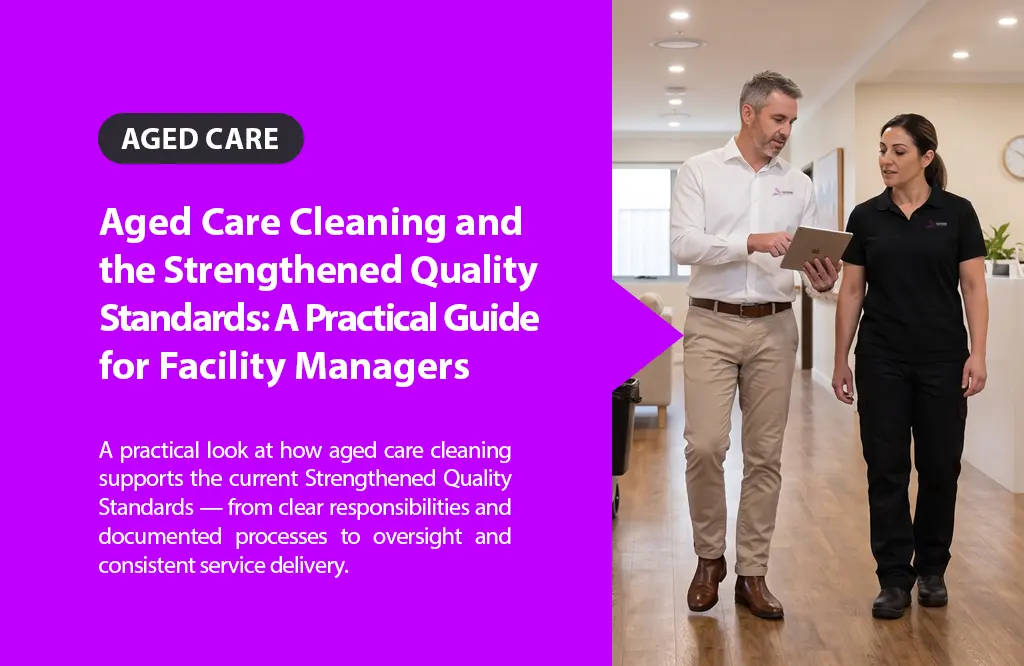
A facility can look clean and still have gaps in the systems behind it. Effective aged care cleaning depends on clear responsibilities, consistent processes and oversight that works every day — not just when an audit is approaching.
For an aged care facility, being clean isn’t simply about looking presentable when someone walks through the front door.
Residents need to be able to live comfortably in their rooms and shared spaces. Bathrooms need to be maintained appropriately. Spills and hazards need to be addressed. Cleaning responsibilities need to be clear. Maintenance issues need to be identified and escalated. And the systems behind all of this need to work consistently — not just when an audit is approaching.
The Strengthened Aged Care Quality Standards reinforce the importance of the environment in which care is delivered.
For facility managers, this raises an important question:
How do you demonstrate that your cleaning systems are actually working?
A clean-looking facility is part of the picture. But good environmental management also depends on the systems behind what you can see — clear responsibilities, documented processes, appropriate frequencies, supervision, records, reporting and action when something goes wrong.
Understanding Quality Standard 4: The Environment
Quality Standard 4 focuses on the environment in which older people receive care and services.
For residential aged care providers, the physical environment needs to support people’s safety, comfort, independence and quality of life.
Cleaning forms one part of that much broader responsibility.
From an environmental cleaning perspective, this means thinking beyond whether floors have been vacuumed or bathrooms have been cleaned.
It means considering whether the cleaning program consistently supports an environment that is:
- clean and hygienic
- safe for residents, staff and visitors
- comfortable and appropriate for residents
- maintained to an appropriate standard
- responsive when problems are identified.
This is where the distinction between cleaning tasks and a cleaning system becomes important.
Tasks get the facility cleaned.
Systems help make sure it stays that way.
What Does "Clean, Safe and Comfortable" Look Like in Practice?
These words sound simple until you try to apply them across an operating residential aged care facility.
“Clean” isn’t just a polished reception area.
It is the resident bathroom at the end of the corridor. The underside of a dining chair. The handrail used throughout the day. The corners of a resident room. The communal lounge after an activity. The shared bathroom during a busy shift.
“Safe” isn’t only about cleaning either.
A cleaner may notice a loose grab rail, damaged flooring, a leak, an obstruction or another potential hazard while working through the facility.
The question then becomes: what happens next?
And “comfortable” matters because these aren’t simply commercial spaces.
They are places where people live.
Strong environmental cleaning therefore needs to combine cleanliness with respect for residents, safe working practices, appropriate scheduling and clear processes for identifying and escalating issues.
An Audit Shouldn't Change How the Facility Is Cleaned
The days leading up to an audit can understandably create additional pressure.
Managers review documentation. Teams check outstanding actions. Areas of the facility receive extra attention. Records are brought together.
But ideally, the cleaning system shouldn’t need to become a completely different system because an audit is approaching.
If the everyday processes are working properly, the evidence should already exist.
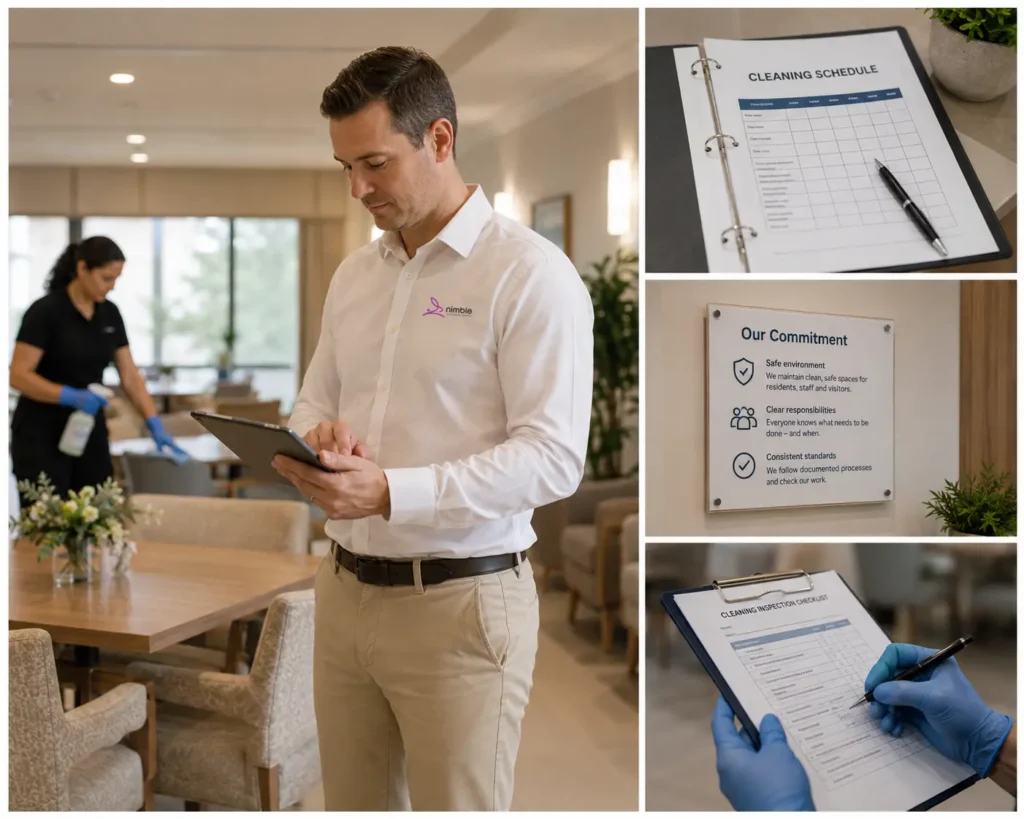
Cleaning schedules should already be in place.
Responsibilities should already be assigned.
Inspections should already be occurring.
Problems should already be recorded and followed up.
That’s a much stronger position than trying to reconstruct months of cleaning activity shortly before it needs to be demonstrated.
Audit readiness is easier when it is the result of everyday operations rather than an event of its own.
Start With One Simple Question: Who Is Responsible for What?
Cleaning responsibilities in aged care can become complicated surprisingly quickly.
Commercial cleaners may clean resident rooms and bathrooms. Care staff may have responsibility for particular resident equipment. Catering teams may manage certain kitchen or dining functions. Maintenance teams deal with repairs. Facility staff may respond to incidents between scheduled cleaning visits.
Without clear boundaries, gaps can appear.
Consider something as simple as a shared mobility aid.
Who cleans it?
How often?
After which type of use?
What product should be used?
Where is that responsibility documented?
The problem isn’t necessarily that nobody is willing to do it. Sometimes two teams simply assume the other team is responsible.
A well-developed cleaning system should clearly identify:
what needs to be cleaned, who is responsible, when it needs to happen and how it should be done.
That clarity benefits the cleaner, the facility team and management.
“Strong cleaning standards aren’t built for audit day. They’re built into what happens every day.”
What Should an Aged Care Cleaning Policy Cover?
The facility’s cleaning policy should establish the framework for how environmental cleaning is managed.
The exact requirements will depend on the facility and its broader policies and procedures, but cleaning documentation may address areas such as:
- cleaning responsibilities
- cleaning frequencies
- routine and periodic cleaning
- high-touch surfaces
- resident rooms and bathrooms
- communal and shared areas
- cleaning methods
- products and equipment
- infection prevention procedures
- spill response
- waste handling
- personal protective equipment
- management of cleaning equipment
- outbreak or increased-risk cleaning arrangements
- reporting and escalation
- inspection and quality assurance
- record keeping.
The objective isn’t to create paperwork for the sake of paperwork.
A useful policy should answer the practical questions that arise when people are actually doing the work.
If a cleaner encounters a situation they don’t recognise, the system should help them understand what to do — or who to ask.
Cleaning Schedules Need More Detail Than Room Names
A cleaning checklist that says “Resident room – clean daily” leaves a lot open to interpretation.
Does that include the bed surrounds? Door handles? Light switches? Furniture? Accessible high-touch surfaces? What about periodic detailed cleaning?
The same issue applies to bathrooms and communal areas.
A more useful cleaning schedule breaks spaces into the surfaces and tasks that actually need attention.
Resident bedrooms
Depending on the facility’s requirements and agreed scope, this may include:
- floors
- accessible furniture surfaces
- high-touch points
- door handles
- light switches
- waste bins
- ledges and accessible surfaces
- periodic detailed cleaning tasks.
Resident bathrooms
This may include:
- toilets
- basins
- tapware
- mirrors
- grab rails
- shower areas
- floors
- door handles
- high-touch surfaces
- waste bins.
Communal areas
Depending on the space:
- tables
- chairs and chair arms
- high-touch points
- handrails
- doors and handles
- accessible furniture surfaces
- floors
- waste bins
- shared fixtures.
The facility-specific schedule can then assign appropriate frequencies and responsibilities.
That makes the cleaning expectation much easier to communicate, supervise and verify.
Cleaning Records: What Are You Actually Trying to Demonstrate?
Documentation should have a purpose.
A pile of completed checklists doesn’t necessarily tell management whether the cleaning program is effective.
Useful cleaning records may help demonstrate things such as:
- scheduled cleaning has occurred
- required inspections have been completed
- additional cleaning was requested and actioned
- identified problems were followed up
- periodic cleaning tasks were completed
- corrective actions were implemented
- outbreak or additional cleaning occurred where required.
The precise records a facility needs to maintain will depend on its systems and requirements.
But from an operational perspective, the principle is straightforward:
Records should help you understand what was supposed to happen, what actually happened and what was done when something didn’t go to plan.
"It Looks Clean" Isn't a Complete Quality-Control System
Visual inspection is valuable.
If a bathroom is visibly dirty, something has clearly gone wrong.
But visual appearance alone has limitations.
A surface can look clean while a frequently touched point has been missed. A room can present well even though a periodic task is overdue. A checklist can be signed even though the standard of cleaning is inconsistent.
A stronger quality-assurance process may combine several measures, such as:
- visual inspections
- cleaning records
- supervisor inspections
- high-touch-point checks
- completion of periodic tasks
- recurring issue tracking
- facility feedback
- corrective actions
- follow-up inspections
- other verification methods where appropriate.
The important part is what happens with the information.
If the same bathroom repeatedly fails inspection, simply cleaning it again solves today’s problem.
Understanding why it keeps happening may solve tomorrow’s.
Perhaps the scope isn’t clear. Perhaps the allocated time is inadequate. Perhaps training needs reinforcement. Perhaps responsibility is unclear.
Good quality assurance looks beyond the immediate defect.
What Happens When a Cleaner Notices Something That Isn't a Cleaning Issue?
This is another area where good facility systems become important.
Cleaning personnel spend significant time moving through resident rooms, bathrooms, corridors and communal spaces.
That means they may notice things outside the cleaning scope.
For example:
- damaged flooring
- loose fixtures
- water leaks
- damaged furniture
- blocked access
- broken dispensers
- damaged bathroom fittings
- potential trip hazards.
The cleaner may not be the person responsible for fixing the issue.
But there should be a clear process for reporting it.
A simple observation becomes much more valuable when the facility has a system that ensures the information reaches the right person and can be actioned appropriately.
Cleaning and Maintenance Shouldn't Operate in Silos
Cleaning and maintenance are different services, but the condition of the physical environment often brings them together.
A cleaner can’t properly resolve a leaking tap.
Repeatedly cleaning the water around it doesn’t fix the underlying problem.
Likewise, damaged flooring can’t be solved by changing the cleaning method, and mould associated with an unresolved moisture problem may require attention beyond routine cleaning.
This is why communication between cleaning, facility management and maintenance matters.
The objective isn’t for cleaners to diagnose building problems.
It is to have a straightforward pathway for environmental issues to be identified, reported, assigned and resolved.
For facility management, fewer gaps between those functions can mean fewer small problems being allowed to become larger ones.
Identifying Environmental Hazards Before an Audit
A facility shouldn’t need to wait for an external audit to identify environmental problems.
Routine inspections can help identify issues as part of normal operations.
Rather than simply asking:
“Is this area clean?”
An inspection can consider broader questions:
- Are required cleaning tasks being completed?
- Are high-touch surfaces receiving appropriate attention?
- Are cleaning chemicals stored appropriately?
- Is cleaning equipment being managed correctly?
- Are there visible environmental hazards?
- Are damaged surfaces affecting cleanability?
- Are responsibilities clear?
- Are outstanding issues being followed up?
- Are recurring problems appearing in the same areas?
- Is the documentation consistent with what is happening in the facility?
This turns an inspection into a management tool rather than an exercise performed only in preparation for an audit.
Questions to Ask an Aged Care Cleaning Contractor
When selecting a commercial cleaning provider, price and cleaning hours are obviously important.
But they don’t tell you much about how the service will operate once the contract begins.
For an aged care facility, useful questions include:
- How will our cleaning scope be developed?
- How are cleaning frequencies determined?
- How do you manage high-touch surfaces?
- How are cleaners trained for an aged care environment?
- How will site-specific procedures be communicated to cleaners?
- How do you supervise and inspect the service?
- How are cleaning issues recorded and followed up?
- What happens when a cleaner identifies a facility issue outside the cleaning scope?
- How are missed tasks or service problems escalated?
- How can the cleaning program be adjusted if our requirements change?
- How would additional cleaning be coordinated during an outbreak?
- Who is our point of contact when we need something addressed?
One of the most revealing questions may simply be:
“What happens when something goes wrong?”
Every cleaning provider can describe what should happen on a normal day.
How they manage exceptions, problems and changing requirements tells you much more about what they may be like to work with.
Internal Cleaning Teams or a Specialist Cleaning Contractor?
There isn’t one model that is right for every aged care provider.
Some facilities operate internal cleaning teams. Others outsource the service. Larger providers may use a combination of both.
An internal team can offer direct integration with facility operations and close familiarity with residents and the site.
A specialist contractor may provide access to established cleaning systems, training, supervision, relief resources, equipment, quality assurance and specialist support.
The more useful question isn’t necessarily:
“Which model is better?”
It is:
“Which model gives this facility the most reliable cleaning system?”
Whatever model is used, the fundamentals remain similar — clearly defined responsibilities, appropriate training, effective supervision, suitable cleaning methods, documented processes and accountability when standards aren’t met.
Documentation Should Reflect Reality
One of the risks with any compliance system is creating excellent documentation that doesn’t reflect what actually happens on site.
A cleaning manual can be comprehensive.
A checklist can contain every required task.
A policy can describe exactly how an issue should be escalated.
But the real test is whether cleaners know those procedures and follow them consistently.
Ask a cleaner what they do when they find a body-fluid spill.
Ask who they contact when they notice a maintenance hazard.
Ask which surfaces in a particular area receive higher-frequency cleaning.
The answers tell you something that the document alone can’t.
Good documentation supports good practice.
It shouldn’t exist instead of it.
Build Audit Readiness Into Everyday Operations
The strongest cleaning systems aren’t created for auditors.
They’re created for residents and the people running the facility every day.
Clear cleaning schedules make expectations easier for cleaners to understand.
Defined responsibilities reduce gaps between teams.
Routine inspections identify problems earlier.
Useful records help management understand what has occurred.
Clear escalation pathways help get issues to the right person.
Training helps turn procedures into consistent behaviour.
And regular review allows the cleaning program to change as the facility changes.
The fact that these systems can also provide useful evidence during an audit is an important benefit.
But it shouldn’t be the only reason they exist.
A Cleaning Partner Should Make Oversight Easier
Facility managers already have enough moving parts to coordinate.
Cleaning shouldn’t require constant chasing, repeated explanations or waiting until an inspection to discover that standards have slipped.
At Nimble Commercial Cleaning, we approach aged care cleaning as an ongoing operational service rather than simply a list of cleaning tasks.
That means working with facilities to establish clear scopes and cleaning schedules, defined responsibilities, site-specific procedures, regular oversight, reporting and escalation pathways.
We understand that Nimble’s role isn’t to determine whether an aged care provider is compliant with the Aged Care Quality Standards.
Our role is to provide a well-managed cleaning service and the supporting systems that can help the facility maintain a clean, safe and comfortable environment.
Because for facility management, the goal isn’t simply to have a facility that looks ready for an audit.
It’s to have cleaning systems that are working every day.
Looking for a more structured approach to aged care cleaning?
Speak with Nimble about developing a site-specific cleaning program with clear scopes, cleaning schedules, oversight and reporting designed around the way your facility operates.
This one is a particularly good opportunity for Nimble because it moves beyond “we know how to clean aged care facilities” into “we understand these are places where people live.”
I’d make resident dignity and independence the thread running through the whole article, while still speaking practically to the facility manager.