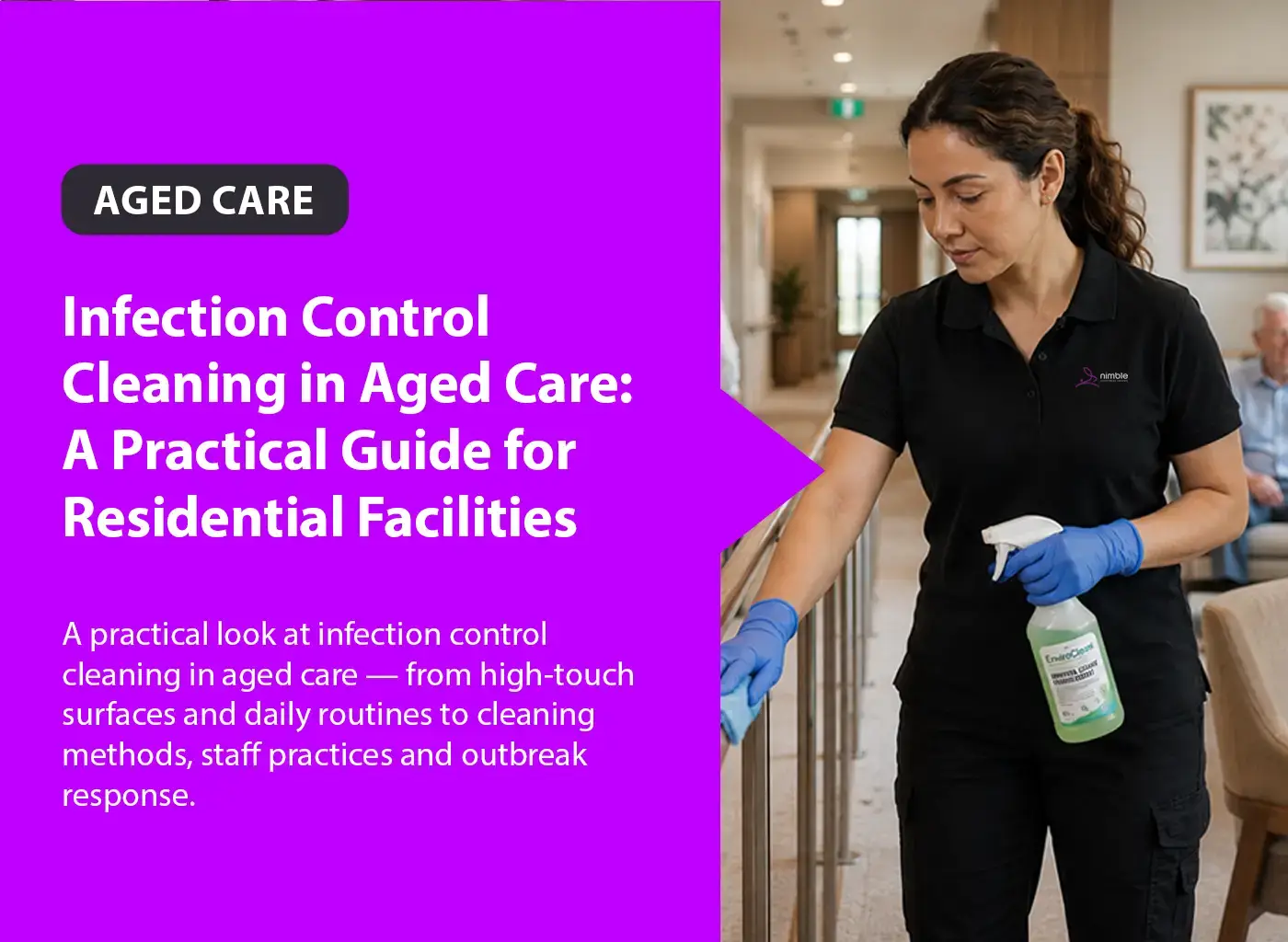
Effective infection control starts with a well-managed aged care cleaning program. Everyday cleaning practices, clear responsibilities and consistent attention to high-touch areas all help support a safer environment for residents, staff and visitors.
Why Aged Care Cleaning Requires a Different Approach
In residential aged care, cleaning has to work around people.
Residents are moving between their rooms, dining areas and communal spaces. Care teams are providing support throughout the day. Families and visitors are coming and going. Meals, activities, appointments and clinical routines continue regardless of the cleaning schedule.
At the same time, many residents may be particularly vulnerable to the consequences of infectious illness.
That makes environmental cleaning an important part of the broader infection prevention approach within an aged care facility — but it also means cleaning needs to be practical, consistent and designed around the way the facility actually operates.
During normal operations, that means getting the everyday details right. During an outbreak or period of increased infection risk, it means being able to adapt quickly.
For facility management, the cleaning provider should be one less thing to worry about.
How Commercial Cleaning Supports Infection Prevention in Aged Care
Aged care facilities are complex environments from a cleaning perspective.
A resident’s bedroom is their personal living space. Bathrooms require a different level of attention. Dining rooms and lounges are shared by many people throughout the day. Corridors and handrails experience constant traffic, while staff, visitors and residents may all interact with the same doors, lifts and communal surfaces.
An effective cleaning program needs to recognise these differences.
Environmental cleaning helps remove dirt, organic matter and contamination from surfaces and forms part of the broader measures used by a facility to reduce infection risk.
Depending on the facility, a cleaning program may cover:
- resident rooms and bathrooms
- communal lounges and dining areas
- corridors, lifts and handrails
- reception and visitor areas
- shared bathrooms and amenities
- staff and administrative areas
- frequently touched surfaces
- shared equipment within the agreed cleaning scope.
But a list of areas alone isn’t enough.
The important questions are what needs to be cleaned, how often, using what method, who is responsible and what changes when infection risk increases.
Those details are what turn a cleaning scope into a working cleaning program.
Routine Cleaning, Sanitising and Disinfecting Are Not the Same Thing
When infection risk increases, there can be a natural tendency to think that more disinfectant means a safer environment.
In practice, effective environmental cleaning is more considered than that.
Cleaning physically removes dirt, organic matter and contaminants from surfaces. It is fundamental to environmental hygiene and may be required before a disinfectant can work effectively.
Sanitising reduces microorganisms to an appropriate level for the particular application.
Disinfecting involves using an appropriate disinfectant to inactivate microorganisms on a surface, provided the product is suitable and used correctly.
The distinction matters in aged care because cleaning personnel need to understand more than which bottle to pick up.
Product instructions, correct dilution, application method and required contact time can all affect the result.
A cleaning team therefore needs to understand what product is being used, where it should be used, how it should be applied and what process needs to occur beforehand.
High-Touch Surfaces Can Be Recontaminated Quickly
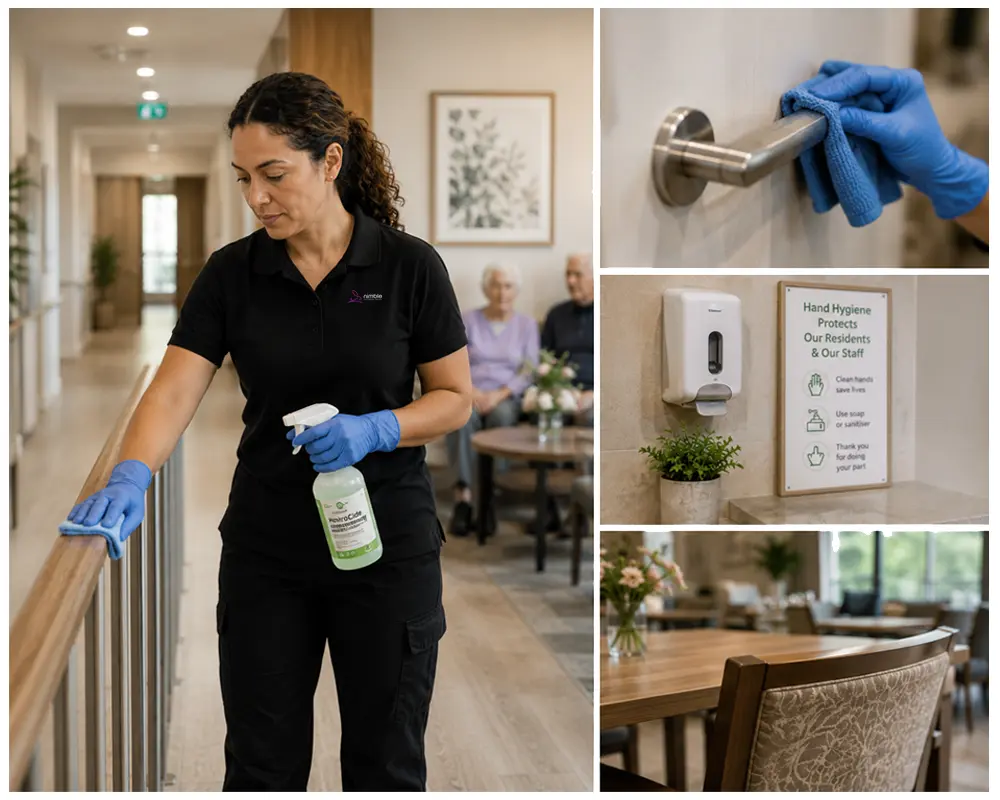
Think about how many people might touch a corridor handrail during a normal day.
Or a lift button. A dining chair. A door handle leading into a communal lounge.
Residents are moving around the facility, staff are providing care, visitors are arriving and leaving, and shared spaces remain active throughout the day.
A surface can therefore be cleaned correctly and become contaminated again soon afterwards.
Common high-touch surfaces can include:
- door handles and push plates
- handrails
- lift buttons
- light switches
- tapware
- toilet flush buttons
- bathroom grab rails
- shared tables
- chair arms
- reception counters
- frequently handled communal fixtures.
This is why high-touch cleaning shouldn’t simply disappear inside a general instruction to “clean the room”.
The important surfaces need to be identified and appropriate cleaning frequencies established based on the facility, how the area is used and the level of risk.
During an outbreak, those frequencies may need to change quickly.
Cleaning Needs to Work Around Residents — Not the Other Way Around
One of the biggest differences between cleaning an aged care facility and many other commercial environments is that the building isn’t empty when cleaning takes place.
It is someone’s home.
Cleaning may be happening while residents are having breakfast, receiving care, participating in activities, spending time with family or simply relaxing in their room.
That changes how cleaning needs to be approached.
Good aged care cleaning isn’t only about completing a checklist. It also means working respectfully around residents, communicating appropriately, managing equipment safely and avoiding unnecessary disruption.
Scheduling matters too.
A dining room may need attention between meal periods. A communal area may need to be cleaned around scheduled activities. Access to a resident’s room may need to accommodate care requirements.
The cleaning plan has to fit the facility — rather than expecting the facility to fit around the cleaners.
Effective infection control cleaning is built on getting the everyday details right — because when infection risk rises, everyday standards matter most.”
Cleaning Sequence Matters
There is also a right order to cleaning.
Moving indiscriminately between different areas can create opportunities for contamination to be transferred from one surface or space to another.
Depending on the area and facility procedures, cleaning generally needs to follow a logical progression, such as working from cleaner areas towards dirtier areas and from higher surfaces towards lower surfaces.
Cleaning equipment, cloths and methods also need to be managed to minimise cross-contamination.
This becomes particularly important when moving between resident bedrooms, bathrooms, communal spaces and other areas with different levels of contamination risk.
The objective is to give cleaning personnel a consistent, repeatable method rather than relying on individual judgement from one cleaner or shift to another.
Who Cleans Shared Mobility Equipment?
This sounds like a simple question until nobody is quite sure of the answer.
A wheelchair may be used in a resident’s room, taken through a corridor and then into a communal space. Walking frames, shower chairs and other mobility aids can similarly move between different areas or, depending on the equipment, between residents.
Depending on the facility and agreed cleaning scope, shared equipment may include:
- wheelchairs
- walking frames
- shower chairs
- mobility aids
- other shared resident equipment.
The key issue is ownership of the task.
Is the item cleaned by the commercial cleaning team? Care staff? Another facility team? And at what point should it be cleaned?
These responsibilities should be clearly established.
Otherwise, seemingly minor gaps can emerge simply because one team assumes another team is taking care of it.
Blood and Body-Fluid Spills Need a Defined Response
A blood or body-fluid spill isn’t the time to work out the procedure.
Facilities should already have documented processes addressing matters such as controlling access to the affected area, appropriate personal protective equipment, removal of the spill, cleaning and disinfection where required, safe disposal of contaminated materials and hand hygiene.
For cleaning personnel, there is another important element: knowing their role and when to escalate.
A cleaner shouldn’t be left deciding how an unfamiliar situation should be managed.
Facility procedures, training, responsibilities and reporting lines should be clear before an incident occurs so the appropriate response can begin without unnecessary uncertainty.
A Good Cleaning Schedule Removes Ambiguity
One of the easiest ways for cleaning standards to become inconsistent is for the scope to be too broad.
“Clean communal areas daily” sounds straightforward.
But does that include the handrails? Chair arms? Door handles? Light switches? How frequently are they cleaned? Who cleans shared equipment? What happens if an area requires additional attention during the day?
A good aged care cleaning schedule removes as much of that ambiguity as possible.
It should establish:
What is cleaned
The rooms, surfaces, fixtures and equipment included within the cleaning scope.
How often it is cleaned
Daily cleaning, periodic detailed cleaning and higher-frequency cleaning of particular surfaces or areas where required.
How it is cleaned
The required method, equipment and cleaning products.
Who is responsible
Particularly where responsibilities may sit across cleaners, care staff, catering teams, maintenance personnel or other facility staff.
What changes when infection risk increases
The additional cleaning requirements that may be activated during an outbreak or other elevated-risk period.
This creates a clear baseline for normal operations while giving facility management a framework that can be adjusted when circumstances change.
When an Outbreak Changes Everything
An outbreak can change the operating environment of an aged care facility very quickly.
Areas may need to be isolated. Resident movements can change. Staff are managing additional infection-control requirements. Families may understandably be concerned. Facility management may be coordinating multiple operational and clinical priorities at once.
The last thing management needs at that point is uncertainty about whether the cleaning provider can respond.
During normal operations, consistency is critical.
During an outbreak, responsiveness becomes just as important.
Cleaning frequencies may need to increase, additional areas may require attention, different procedures may be introduced and resources may need to be adjusted.
A cleaning provider working in aged care needs to be prepared for that reality.
What Should Happen in the First 24 Hours of an Outbreak?
The exact response will depend on the facility, the nature of the outbreak and instructions from facility management and the relevant infection prevention personnel.
From an environmental cleaning perspective, early priorities may include:
1. confirming affected areas and any access restrictions
2. understanding instructions from facility management or the infection prevention lead
3. identifying areas requiring increased cleaning or disinfection
4. increasing attention to relevant high-touch surfaces
5. confirming appropriate products, PPE and equipment are available
6. allocating cleaning personnel appropriately
7. reinforcing cleaning methods and cross-contamination controls
8. establishing clear communication and escalation arrangements
9. documenting additional cleaning activities where required.
Importantly, the commercial cleaning provider isn’t there to develop or direct the facility’s clinical outbreak response.
Its role is to understand the environmental cleaning requirements that form part of that response and be capable of implementing them effectively.
For facility management, that distinction matters. You need a provider that understands its role, communicates clearly and can respond without creating another issue for your team to manage.
How a Cleaning Contractor Can Support an Outbreak Management Plan
The best time to discuss outbreak cleaning arrangements isn’t during an outbreak.
A cleaning provider should understand in advance that requirements may need to change quickly and have a clear process for responding when they do.
Depending on the facility’s outbreak management plan, that might involve:
- increasing cleaning frequencies
- additional high-touch-point cleaning
- enhanced cleaning or disinfection of nominated areas
- allocating additional cleaning resources where required
- reinforcing PPE and cleaning procedures
- separating equipment between designated areas
- clear reporting and escalation
- documenting additional cleaning activities.
There also needs to be a reliable communication pathway.
Facility management shouldn’t have to chase multiple people to find out whether additional cleaning has been arranged or an issue has been addressed.
When circumstances change quickly, knowing who to contact — and knowing they will respond — becomes particularly important.
Common Cleaning Mistakes That Can Increase Infection Risk
Many cleaning problems aren’t caused by a complete absence of cleaning.
They come from small inconsistencies repeated across hundreds of tasks.
Common issues can include:
- frequently touched surfaces being overlooked
- using the same cloth or equipment across
- inappropriate areas
incorrect chemical dilution - failing to observe required disinfectant contact times
- applying disinfectant without cleaning first where required
- moving from dirtier areas back into cleaner areas without appropriate controls
- unclear responsibility for shared equipment
- inconsistent cleaning frequencies
- insufficient cleaning of reusable cleaning equipment
- poor documentation or reporting of missed tasks.
These are also reasons why supervision matters.
A written cleaning scope doesn’t guarantee that the same standard is being delivered every day, across every area and every shift.
Training, inspection, feedback and corrective action are what help turn the documented process into consistent performance.
Selecting Products for Infection Control and Resident Safety
Aged care facilities are living environments, so product selection needs to consider both cleaning effectiveness and how products will be used around residents, staff and visitors.
Considerations may include:
- intended use
- manufacturer instructions
- suitability for the surface
- correct dilution
- application method
- required contact time
- safe handling and storage
- the environment in which the product will be used.
Using more chemical isn’t necessarily better.
The objective is to use appropriate products correctly, consistently and in accordance with the facility’s requirements.
Cleaning personnel should also know what they are using. Clearly documented procedures and appropriate training reduce the likelihood of individual cleaners making their own decisions about products or dilution.
How Do You Know the Cleaning Is Actually Working?
This is an important question for any facility manager.
A completed cleaning checklist tells you that a task has been recorded as complete. It doesn’t necessarily tell you how well it was performed.
Regular verification helps close that gap.
Depending on the facility and cleaning program, this may involve:
- routine visual inspections
- cleaning checklists and records
- supervisor inspections
- high-touch-point audits
- reviewing recurring cleaning issues
- feedback from facility staff
- corrective actions and follow-up inspections
- additional verification methods where appropriate.
The objective shouldn’t be to catch cleaners doing something wrong.
It should be to identify problems early, correct them and prevent the same issues from becoming recurring problems.
If the same area is repeatedly being missed, for example, the question isn’t simply who missed it. It may indicate a problem with the cleaning schedule, training, supervision, available time or clarity of responsibility.
Good oversight looks for the cause as well as the symptom.
Infection Prevention Starts Before an Outbreak
An outbreak places a cleaning program under pressure, but it also reveals how strong the everyday systems already are.
If cleaning responsibilities are unclear during normal operations, they are unlikely to become clearer during an outbreak.
If high-touch surfaces aren’t properly identified beforehand, increasing their cleaning frequency becomes more difficult.
If cleaners aren’t familiar with the facility’s procedures, an outbreak isn’t the ideal time for them to learn.
The strongest foundation is therefore a well-managed everyday cleaning program with clearly defined responsibilities, appropriate cleaning frequencies, trained personnel, suitable products, documented procedures and effective oversight.
Then, when circumstances change, the facility isn’t starting from scratch.
It is adapting an established system.
A Cleaning Partner That Understands the Environment
For facility managers and care teams, commercial cleaning should make the operation of the facility easier — not add another layer of management.
That means consistent everyday cleaning, but it also means having a provider that understands the realities of residential aged care: residents living in the spaces being cleaned, competing operational priorities, high standards of hygiene, clearly defined responsibilities and the need to respond when circumstances change.
At Nimble Commercial Cleaning, our approach is built around those realities.
We work with aged care facilities to develop site-specific cleaning programs covering routine cleaning, high-touch areas, cleaning responsibilities, frequencies and the additional support that may be required when infection risk increases.
Because when everything is running normally, you need consistency.
And when circumstances change, you need a cleaning partner that responds.
Looking for a cleaning partner for your aged care facility?
Speak with Nimble about a cleaning program designed around your facility, your residents and the way your team operates.