Aged care cleaning happens in the middle of everyday life. Residents are moving through the facility, meals and activities are underway, families are visiting and care continues — all while the cleaning still needs to get done.
A clean aged care facility isn’t necessarily a good aged care environment.
It can be spotless and still have a slippery floor.
It can smell strongly of disinfectant and feel more clinical than comfortable.
A corridor can be freshly cleaned but difficult for a resident using a walking frame to navigate because cleaning equipment has been left in the way.
And a resident’s room can be cleaned perfectly according to a checklist while the way the cleaning was carried out left the person feeling uncomfortable in their own space.
That’s what makes cleaning residential aged care different from cleaning many other commercial environments.
The environment needs to be clean and hygienic, but it also needs to be safe, comfortable and respectful of the people who live there.
For facility managers, the challenge is getting all of those things working together.
An Aged Care Facility Is a Workplace — But It's Also Someone's Home
For the cleaning team, a resident room may be one of many rooms on a schedule.
For the person living there, it is their personal space.
Their photographs may be on the bedside table. Their belongings are in the room. They may be resting, watching television, speaking with family or receiving care when the cleaner arrives.
That distinction should influence how cleaning is carried out.
Good aged care cleaning means completing the required tasks while respecting the resident’s privacy, belongings, routines and dignity.
It can mean communicating before entering or beginning work, being mindful when moving personal items, working around care activities and recognising when it may be better to return at another time.
The cleaning schedule matters.
But so does the person whose room is being cleaned.
Clean Floors Also Need to Be Safe Floors
Floor cleaning is one of the most visible parts of any commercial cleaning program.
In aged care, it also needs to be considered from the perspective of residents who may have reduced mobility, use walking aids or be at greater risk of falling.
A beautifully presented floor isn’t much of an achievement if it creates an unnecessary slip hazard.
Safe floor care involves more than mopping.
Depending on the flooring and facility, consideration may need to be given to:
- appropriate cleaning methods
- suitable cleaning products
- correct chemical dilution
- wet-floor management
- cleaning equipment and cords
- drying time
- spills
- floor condition
- transitions between different flooring surfaces
- damaged or lifting flooring.
Timing can be important too.
Cleaning a busy corridor during a high-traffic period may create unnecessary inconvenience and increase the interaction between residents and cleaning operations.
Where practical, cleaning schedules should take into account how and when different areas of the facility are used.
Poor Floor Maintenance Can Affect Mobility
Not every floor-related risk is a cleaning problem.
Loose flooring, damaged transitions, uneven surfaces, worn finishes or other deterioration may require maintenance rather than additional cleaning.
But cleaners are often well positioned to notice these issues.
They work across the same floors repeatedly and may see changes developing over time.
The important question is what happens when they do.
A cleaning provider shouldn’t be expected to diagnose building defects, but there should be a simple pathway for the cleaner to report a potential issue so facility management or maintenance personnel can assess it.
This is where cleaning and maintenance need to communicate.
Repeatedly cleaning around a problem isn’t the same as resolving it.
Slips, Trips and Falls: Small Details Matter
Not every hazard is dramatic.
Sometimes it is a cleaning trolley positioned awkwardly in a corridor.
A power lead crossing a walkway.
A wet entrance after rain.
A spill that hasn’t yet been reported.
An object left near a doorway.
A mat that has shifted.
For an independently mobile person, these might be minor inconveniences.
For an older person with reduced mobility, impaired vision or balance difficulties, they can be much more significant.
Cleaning personnel therefore need to think not only about the surface they’re cleaning, but also about the environment they create while doing it.
Equipment should be positioned appropriately. Access routes should remain clear where possible. Wet areas should be managed carefully. Spills and hazards need to be addressed or escalated promptly.
Good cleaning shouldn’t introduce a new hazard while removing another one.
“Residents experience more than the end result of cleaning. They experience how it happens around them — and sometimes the smallest details make the biggest difference.”
Safe Corridors Need More Than Clean Floors
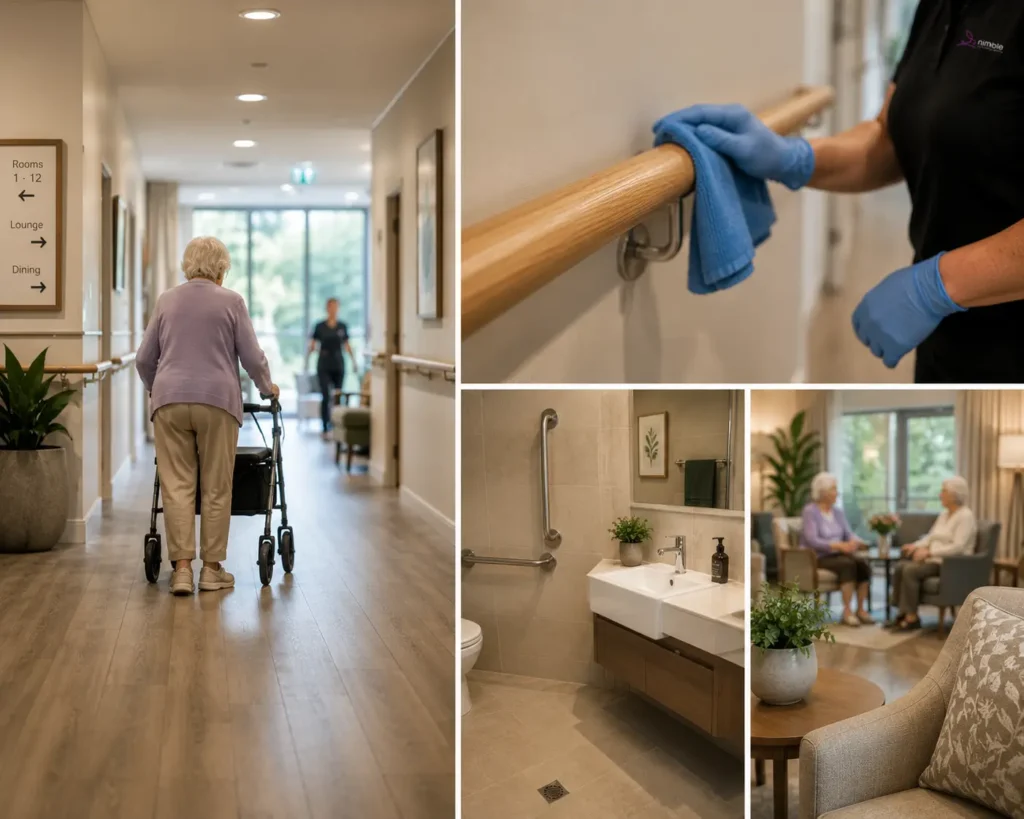
Corridors are central to everyday movement through a residential aged care facility.
Residents may walk independently, use mobility aids, travel with staff or move between their rooms, dining areas, lounges and outdoor spaces throughout the day.
That makes corridor safety particularly important.
Regular attention may include:
- floor cleanliness and condition
- spills and moisture
- unobstructed access
- handrails
- lighting issues
- transitions between floor surfaces
- mats
- doors and thresholds
- cleaning equipment or other temporary obstructions.
Handrails deserve particular attention because they serve two purposes.
They are frequently touched surfaces requiring regular cleaning, but they are also mobility supports that residents may rely on.
Cleaning needs to achieve the first without compromising the second.
Entrances and Ramps Change with the Weather
The entrance that was perfectly safe at 9:00 am may look very different after an afternoon of heavy rain.
Water can be tracked inside. External paths can become wet. Leaves and debris may accumulate. Mats can become saturated or move from position.
Ramps and accessible pathways require similar attention.
This highlights an important principle of environmental management:
Some risks aren’t fixed. They change throughout the day.
Cleaning programs and facility inspections therefore need enough flexibility to respond when conditions change rather than relying entirely on predetermined frequencies.
Bathrooms Deserve Particular Attention
Resident bathrooms bring together several important considerations: hygiene, moisture, mobility, privacy and accessibility.
They can also contain numerous surfaces residents physically rely upon.
A bathroom inspection may consider areas such as:
- floor condition
- water or moisture
- grab rails
- shower areas
- toilets
- basins and tapware
- accessible pathways
- waste
- lighting
- fixtures and fittings.
Again, cleaning and maintenance responsibilities can intersect.
Cleaning may remove contamination and moisture.
It cannot repair a loose grab rail.
If a cleaner notices something potentially unsafe, the reporting process needs to be clear enough that the issue reaches the right person quickly.
Stronger-Smelling Doesn't Necessarily Mean Cleaner
There can be a perception that a strong chemical smell demonstrates that an area has been thoroughly cleaned.
In residential aged care, that isn’t necessarily desirable.
Residents live in these spaces throughout the day, and some may be particularly sensitive to strong fragrances or cleaning products.
Product selection may therefore need to consider not only cleaning effectiveness but also how products are used within occupied environments.
Depending on the application, considerations can include:
- suitability for the intended cleaning task
- manufacturer instructions
- surface compatibility
- correct dilution
- odour
- ventilation
- safe handling and storage
- the environment in which the product will be used.
The objective isn’t to make a facility smell like it has been cleaned.
The objective is to clean it effectively.
Noise Is Part of the Cleaning Environment Too
Vacuum cleaners, floor equipment, trolleys and cleaning activities all create noise.
In a shopping centre or office, that may be little more than an inconvenience.
In residential aged care, the impact can be different.
Residents may be sleeping or resting. Activities may be underway. Families may be visiting. Care may be taking place.
Some residents may also find unexpected noise or activity particularly unsettling.
This doesn’t mean cleaning should somehow be silent.
It means cleaning operations should be planned with an awareness of the people around them.
Where practical, noisier tasks can be scheduled appropriately, equipment can be handled thoughtfully and unnecessary disruption can be reduced.
It is a small operational detail that can make a significant difference to how the service feels to residents.
Cleaning Around Residents Living with Dementia
Cleaning around residents living with dementia requires particular awareness.
An unfamiliar person entering a room, furniture being moved, unexpected noise or equipment appearing in a familiar space may be confusing or distressing for some residents.
Cleaning personnel should follow the facility’s procedures and understand the expectations for working within these environments.
Depending on the resident and facility, this may involve simple considerations such as:
- approaching calmly
- communicating appropriately
- respecting personal space
- avoiding unnecessary changes to familiar surroundings
- keeping equipment from obstructing movement
- recognising when assistance from facility staff may be appropriate.
The cleaner’s role isn’t to provide clinical care.
But they are working within a care environment, and their behaviour contributes to the resident’s experience of that environment.
Communal Areas Should Still Feel Like Living Spaces
A lounge should feel like somewhere residents can sit and talk.
A dining room should feel like somewhere people can enjoy a meal.
A courtyard should invite people outside.
Cleaning is necessary to keep those spaces hygienic and well presented, but the end result shouldn’t feel unnecessarily institutional.
That can influence everything from how cleaning equipment is stored to when cleaning is scheduled and the types of products used.
It also reinforces why aged care cleaning isn’t simply transferable from every other commercial setting.
The objective isn’t to turn a residential facility into a clinical-looking environment.
It’s to maintain a clean, safe and comfortable place to live.
Outdoor Areas Matter Too
Resident wellbeing doesn’t stop at the building entrance.
Courtyards, gardens, pathways, outdoor seating areas and accessible external spaces can form an important part of everyday life within a facility.
Environmental upkeep may include attention to:
- pathways and accessible routes
- leaves and debris
- moss or other slippery build-up
- outdoor furniture
- waste
- drainage issues
- trip hazards
- entrances
- ramps and handrails.
Different responsibilities may sit with cleaners, gardeners, maintenance teams or other contractors.
As with internal areas, clarity matters.
If everyone assumes somebody else is checking the courtyard path, problems can be overlooked.
Painting and Maintenance Choices Affect How a Facility Feels
The physical condition of a facility contributes to the resident experience.
Damaged walls, peeling paint, worn finishes, broken fixtures and poorly maintained communal areas can make an otherwise clean facility feel neglected.
Maintenance decisions can also affect safety and practicality.
Flooring needs to be suitable for its environment. Surfaces need to be cleanable. Fixtures should be maintained appropriately. Painting works need to be planned around occupied spaces.
Even colour and finish choices can influence how spaces feel.
For facility management, this is another reason to look at cleaning and maintenance as connected parts of the resident environment rather than completely separate functions.
Cleaning maintains the environment.
Maintenance helps preserve the condition that allows it to be maintained properly.
What Should Facility Managers Look for Each Week?
Formal audits are useful, but regular observation can identify smaller issues before they become larger ones.
A simple weekly environmental walk-through might consider questions such as:
- Are corridors and access routes clear?
- Are floors clean, dry and in good condition?
- Are entrances and ramps safe?
- Are handrails secure and clean?
- Are resident bathrooms presenting appropriately?
- Are there recurring moisture or spill issues?
- Is cleaning equipment stored safely?
- Are communal areas clean without feeling disrupted by cleaning operations?
- Are there damaged fixtures or surfaces?
- Are outdoor pathways and resident areas being maintained?
- Are previously reported issues actually being resolved?
The important part is not simply recording the problem.
It is closing the loop.
Who owns the issue? Has it been reported? What action is required? Has it been completed?
A ten-minute walk-through can be considerably more valuable when those questions have clear answers.
Resident Dignity Can Be Affected by Small Interactions
Aged care cleaning procedures often focus understandably on technical requirements: chemicals, frequencies, equipment, infection prevention and quality control.
But residents experience the service differently.
They experience the person entering their room.
They notice whether their belongings are treated carefully.
They experience the noise.
They notice whether their usual route to the dining room has been blocked by equipment.
They notice how the facility smells and feels after cleaning.
These aren’t necessarily things that appear on a cleaning checklist.
But they matter.
A good aged care cleaning program therefore needs both technical standards and appropriate behaviour.
Training should address both.
The Best Cleaning Program Is One Residents Barely Need to Think About
In many ways, successful aged care cleaning should blend into the operation of the facility.
Residents shouldn’t constantly have to navigate around trolleys and equipment.
Facility staff shouldn’t repeatedly have to chase missed tasks.
Managers shouldn’t need to explain the same site requirements to different cleaners.
Cleaning shouldn’t unnecessarily interfere with meals, activities, rest or care.
The work still needs to happen — thoroughly and consistently.
But it should happen in a way that fits around the people living and working within the facility.
That’s an important difference between simply cleaning an aged care building and understanding an aged care environment.
Creating an Environment That Supports Safety, Comfort and Independence
The Strengthened Aged Care Quality Standards place importance on environments that support older people to move freely, feel safe and receive care and services in surroundings that meet their needs.
Cleaning forms only one part of that broader responsibility.
But it touches almost every part of the physical environment.
Floors need to be clean without creating unnecessary slip risks.
Bathrooms need to be hygienic while remaining accessible.
Handrails need to be cleaned while remaining available to the residents who rely on them.
Communal spaces need to be maintained without losing their sense of comfort.
Resident rooms need to be cleaned with respect for the fact that they are personal spaces.
And when cleaners identify something outside their scope, there needs to be a clear way to get that information to the people who can act on it.
That requires more than a cleaning checklist.
It requires a cleaning program designed around the environment in which it operates.
Aged Care Cleaning Should Support the People Who Live There
At Nimble Commercial Cleaning, we understand that the best result isn’t simply a facility that looks clean.
It’s a facility where cleaning supports the people who live and work there.
That means considering resident routines when planning cleaning, reducing unnecessary disruption, maintaining safe access, working respectfully within personal spaces, identifying and reporting environmental issues and coordinating cleaning around the realities of an operating aged care facility.
Our role isn’t to determine how a facility delivers care.
Our role is to provide cleaning and facility support that works effectively within that environment.
Because in aged care, how the cleaning is carried out matters just as much as whether the cleaning gets done.
Looking for an aged care cleaning provider that understands the environment?
Speak with Nimble about a site-specific cleaning program designed around your facility, your operations and the people who call it home.