At a glance, cleanliness in aged care can seem straightforward. Surfaces are cleaned, floors are maintained, and routines are in place. But over time, what stands out isn’t whether cleaning is being done — it’s how consistently the environment holds its standard.
It’s a Space That Doesn’t Reset
Unlike many commercial environments, aged care cleaning doesn’t have a clear reset point. There’s no moment where the space empties out completely and starts again. Instead, the environment carries through:
- from one shift to the next
- from one day to the next
- across shared spaces that are in constant use
That continuity changes how consistency shows up.
Small Variations Start to Appear
What tends to happen isn’t a drop in standard — it’s variation. It might look like:
- Certain areas getting more attention than others
- Details being picked up one day, but not the next
- Small inconsistencies between shifts
- Elements that are technically clean, but slightly uneven in presentation
None of this is immediate or obvious. But over time, it creates a sense that things aren’t quite holding the same way.
The Environment Is Always Being Observed
In aged care, the environment is constantly experienced rather than passed through.
- Residents spend extended time in the same spaces
- Staff move through areas repeatedly across the day
- Families notice subtle changes between visits
Because of that, consistency becomes less about a single moment, and more about what holds over time.
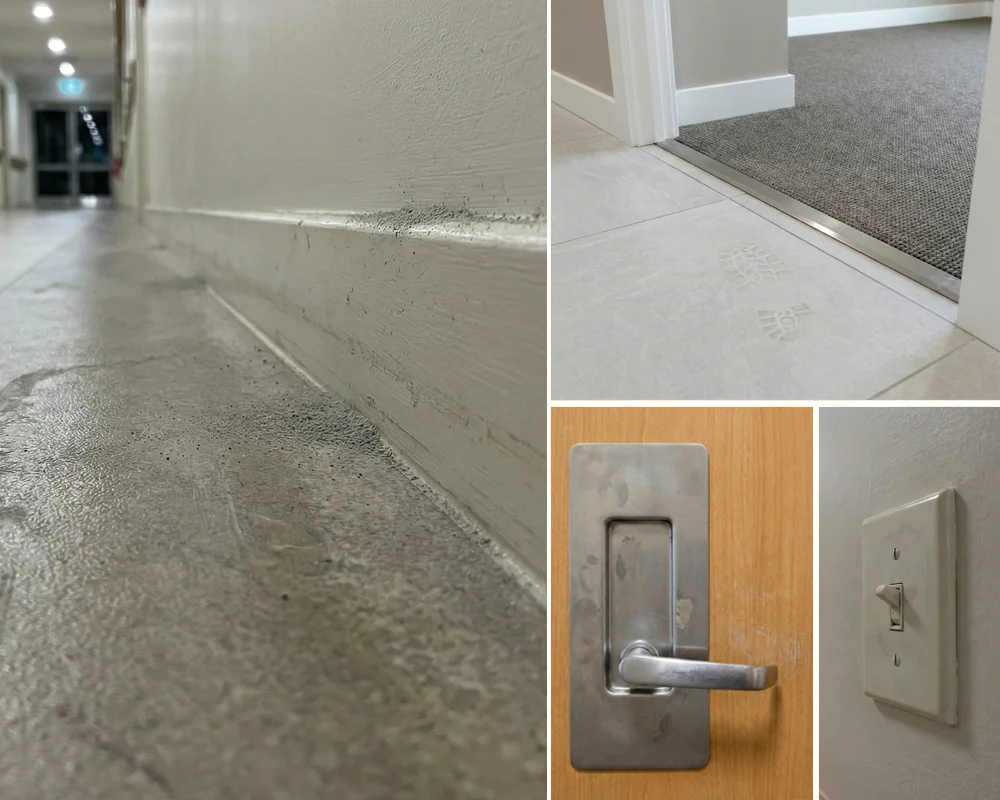
It’s Often the Less Visible Areas
Like most environments, the more visible areas tend to be maintained well. Where variation shows up more often is in:
- Edges and corners
- Handrails and touchpoints
- Less prominent shared spaces
- Areas that sit just outside the main routine
These aren’t major issues. But they tend to build gradually, and shift the overall feel of the space.
Like most environments, the more visible areas tend to be maintained well. Where variation shows up more often is in areas that sit just outside the main routine.
Timing Still Plays a Role
Even without a traditional “peak period,” timing still matters. Cleaning that doesn’t align with how spaces are used can lead to:
- Areas being reset too early
- Standards dropping off before the next round
- Small details being left until later
Again, not a failure — just a misalignment over time.
It Becomes Something That Needs Watching
When consistency isn’t quite holding, it rarely shows up all at once. It becomes something that sits in the background:
- needing to be noticed
- occasionally followed up
- kept an eye on
Not urgent — but present.
A Final Thought
In aged care, the difference isn’t usually between clean and unclean. It’s between environments that hold their standard consistently, and those that vary slightly over time.
And in spaces like these, it’s often that variation — however small — that ends up being noticed most.